














Pyrite Stone Bracelet Benefits: How to Wear, Which Hand & Real vs Fake
Pyrite — the brilliant golden stone often called “fool’s gold” — is one of India’s most popular crystals for wealth, money and business success. Worn as a pyrite bracelet, it becomes an everyday talisman for abundance, confidence and protection. This guide covers pyrite bracelet benefits, exactly how to wear it (which hand and day), how to activate and care for it, and how to tell a genuine pyrite bracelet from a fake.
What Is a Pyrite Bracelet?
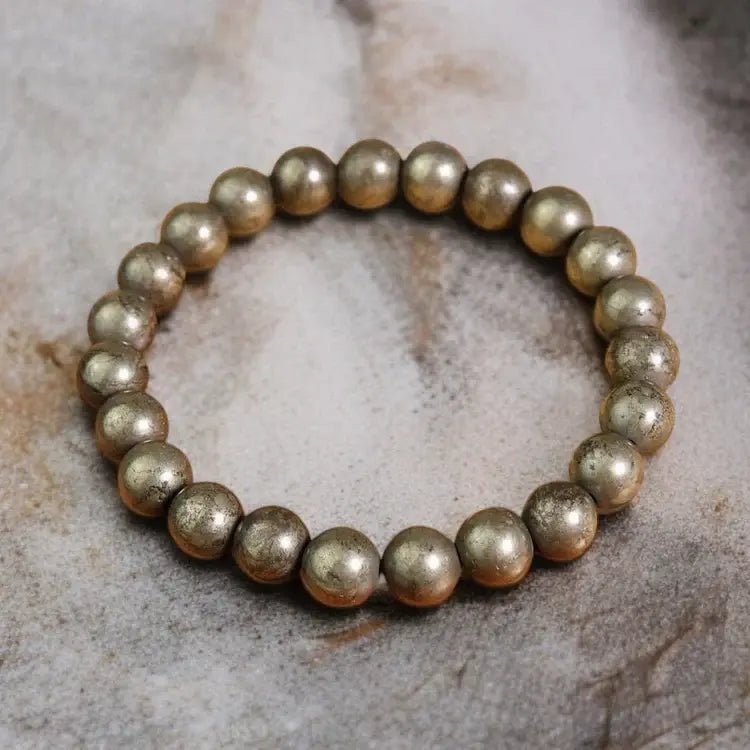
A pyrite bracelet is a string of natural pyrite beads worn on the wrist. In Vedic and crystal-healing traditions, pyrite is linked to the Solar Plexus chakra and the fiery energy of Mars and the Sun — the seat of willpower, confidence and personal power. Because it sits against the skin all day, a bracelet is the easiest way to keep pyrite’s prosperity energy with you.
Pyrite, the mineral: what you are actually wearing
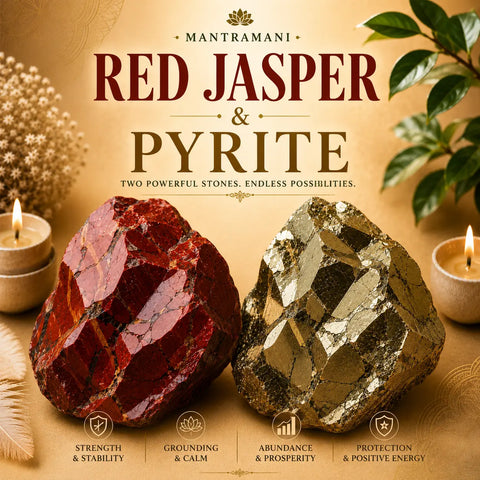
Pyrite is iron disulphide — FeS₂ — and it is a genuine mineral, not a manufactured one. It crystallises in cubes so regular that people who find them in the field routinely assume someone carved them. Hardness sits at 6 to 6.5 on the Mohs scale, which is harder than a steel knife blade and softer than quartz, and its specific gravity is about 5.0. That last number is the one that matters on your wrist: pyrite is roughly twice as heavy as an equivalent bead of quartz, and you can feel it the moment you pick the bracelet up.
The nickname “fool’s gold” comes from the colour and the metallic lustre, and it has misled more than one prospector. Gold is soft, malleable and much denser; pyrite is brittle, will not dent under a fingernail, and shatters rather than flattens. The two are not close relatives — they simply share a colour.
The sulphur in the formula is the reason every honest care instruction for pyrite says the same thing: keep it dry. Iron sulphide reacts with moisture and oxygen, and the reaction dulls the surface. This is chemistry, not a defect, and it is covered further down.
Pyrite Bracelet Benefits
- Attracts wealth & abundance — pyrite is the classic “money magnet” stone, drawing financial opportunity and cash flow.
- Supports business growth — a favourite of entrepreneurs and professionals for new opportunities and success.
- Boosts confidence & willpower — strengthens the Solar Plexus, raising self-belief and drive.
- Shields your aura — forms a protective layer against negativity, jealousy and energy drain.
- Improves focus & clarity — supports logical thinking for work, business and exams.
Explore energized options in our Pyrite collection and the Money Magnet Bracelet range.
Who Should Wear a Pyrite Bracelet?
Pyrite suits business owners, entrepreneurs, salespeople, students and anyone working toward financial goals or recovering from money struggles. It resonates especially with Leo and Aries. For broader money remedies, see Money & Wealth and Business & Career.
Bead size and wrist sizing — settle this before you settle on the stone
Most pyrite bracelets in India are strung at 8 mm or 10 mm. The difference is not cosmetic. At 10 mm a bracelet carries noticeably more mineral, sits higher off the wrist, and — because pyrite is dense — weighs enough that some wearers notice it by evening. At 8 mm it disappears under a shirt cuff.
Measure the wrist properly
Wrap a strip of paper around the wrist just below the wrist bone, mark where it overlaps, and measure the strip flat against a ruler. Do not use a stretched tape and do not guess from a ring size. Most adult Indian wrists measure between 15 cm and 19 cm.
Then add ease, and add more for bigger beads
Add roughly 1.5 cm to the wrist measurement for an 8 mm strand and roughly 2 cm for a 10 mm strand. Larger beads need more slack because the strand has to travel around the outside of each bead, so a bracelet cut to the exact wrist measurement will sit tight and will not rotate.
Four signs the fit is wrong
- It leaves a mark on the skin after a few hours — too tight.
- It slides over the wrist bone onto the hand — too loose, and the elastic will fail sooner.
- The beads will not rotate when you push them with a finger — too tight.
- You can slip two fingers under the strand — too loose.
Elastic, knotted thread or adjustable
Elastic is the standard and the most forgiving; it also has the shortest life, because the cord degrades before the stone does. Knotted thread lasts longer and keeps the beads from scattering if it breaks, but has no give at all, so the sizing above has to be right. An adjustable slider is the safe choice when you are buying as a gift and cannot measure the wrist.
How to Wear a Pyrite Bracelet
Which hand?
Wear your pyrite bracelet on the right (dominant/projective) hand to send your intention of wealth and success outward into action. (The left wrist is the receiving side, used for calming, inward-focused stones.)
Best day & time
First wear it on a Thursday or Sunday morning after a bath, with a clear intention for wealth, confidence or success.
Activation
Hold the bracelet in both palms, close your eyes, and state your intention three times. Place it in morning sunlight for a few hours to charge.
Cleansing — important
Do not wash pyrite with water — it contains iron and can tarnish or rust. Cleanse it with sunlight or by resting it on a selenite plate overnight. Recharge monthly.
Real vs Fake: How to Spot a Genuine Pyrite Bracelet
- Weight & feel — real pyrite is dense and metallic, and feels cool to the touch.
- Colour — a brassy, pale-gold metallic shine (not bright yellow plastic or painted beads).
- Natural variation — genuine beads show slight differences; perfectly identical, glassy beads are a red flag.
- Certificate — always buy lab-certified natural pyrite. Every MantraMani pyrite bracelet is 100% natural, government lab-certified and comes with a Certificate of Authenticity.
Five checks you can run on a pyrite bracelet before you pay
Every one of these can be done with the bracelet in your hand, in a shop, with no equipment. None of them requires you to trust the seller, and none of them requires a laboratory. Run them in this order.
1. Heft it against something the same size
Pyrite’s specific gravity of about 5.0 makes it roughly twice as heavy as glass, resin or dyed howlite of the same bead size. Hold the pyrite strand in one hand and any ordinary 8 mm quartz or glass bracelet in the other. Real pyrite is unmistakably the heavier of the two, and the difference is large enough that you do not need a scale. This single test eliminates most imitations.
2. Look into the drill hole
The drill hole exposes the inside of the bead, which is where coatings and dyes give themselves away. Natural pyrite is the same brassy metallic colour all the way through, and the drilled edge is slightly rough. A plated or coated bead shows a different colour inside the hole — grey, white, pale brown — with a visible boundary where the coating stops. If the hole is glossy and perfectly smooth, you are probably looking at moulded resin.
3. Check whether every bead is identical
Natural pyrite grows with visible variation: slight differences in tone from bead to bead, small pits where a crystal face broke away, occasional dark inclusion lines. A strand in which all beads are exactly the same shade, with the same sheen and no pitting anywhere, has almost certainly been coated, plated or moulded. Perfect uniformity in a natural mineral is the warning sign, not the selling point.
4. Scratch it on unglazed porcelain
Pyrite leaves a greenish-black to brownish-black streak on an unglazed ceramic surface — the back of a bathroom tile works, so does the unglazed base of a mug. Gold leaves a yellow streak. Painted brass leaves nothing but flakes of paint. Do this on one bead, on a part of the surface that will not show, and only if the seller permits it.
5. Be suspicious of flawless and cheap together
Either one on its own is fine. A flawless piece can be expensive because it is genuinely rare; a cheap piece can be honest because it is small or lightly included. The combination is the problem. A mirror-bright, perfectly uniform pyrite strand offered well under the market rate is the single most reliable signal in the whole list, and no test above is needed to read it.
What a lab report on pyrite actually tells you
A gemmological report on pyrite is a shorter document than one on a faceted gemstone, because there is less to say. It should name the species, state the weight, and record whether the material has been treated — coated, stabilised, dyed or reconstituted. That is the useful content. Every MantraMani order ships with a report from a government-approved, ISO 9001:2015 certified gemmological laboratory, and the certificate number is printed on the box.
What a report on pyrite does not do is grade it. There is no colour grade, no clarity grade and no cut grade for pyrite the way there is for sapphire, because the trade does not use one. Anyone showing you a “AAA grade” pyrite certificate is showing you a marketing document, not a gemmological one — “AAA” is a supplier’s own label and means whatever that supplier decides it means.
The report also cannot tell you what the bracelet will do for you. It tells you what the material is. That is the whole of its job, and it is worth having precisely because it is narrow.
Where to Buy an Authentic Pyrite Bracelet
Shop genuine, Vedic-energized pyrite bracelets at MantraMani — lab-certified, abhimantrit, with free shipping & COD across India. Browse the Pyrite Bracelet & Crystals collection or premium AAA-grade certified Pyrite.
Shop pyrite at MantraMani
Every piece is lab-certified natural pyrite and energised before dispatch. Browse all 115 in the Pyrite collection.
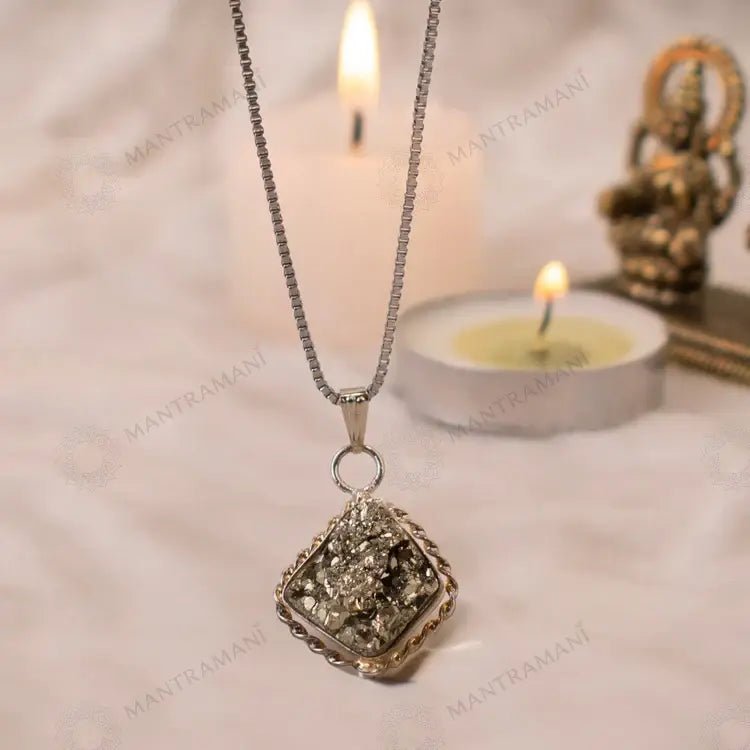
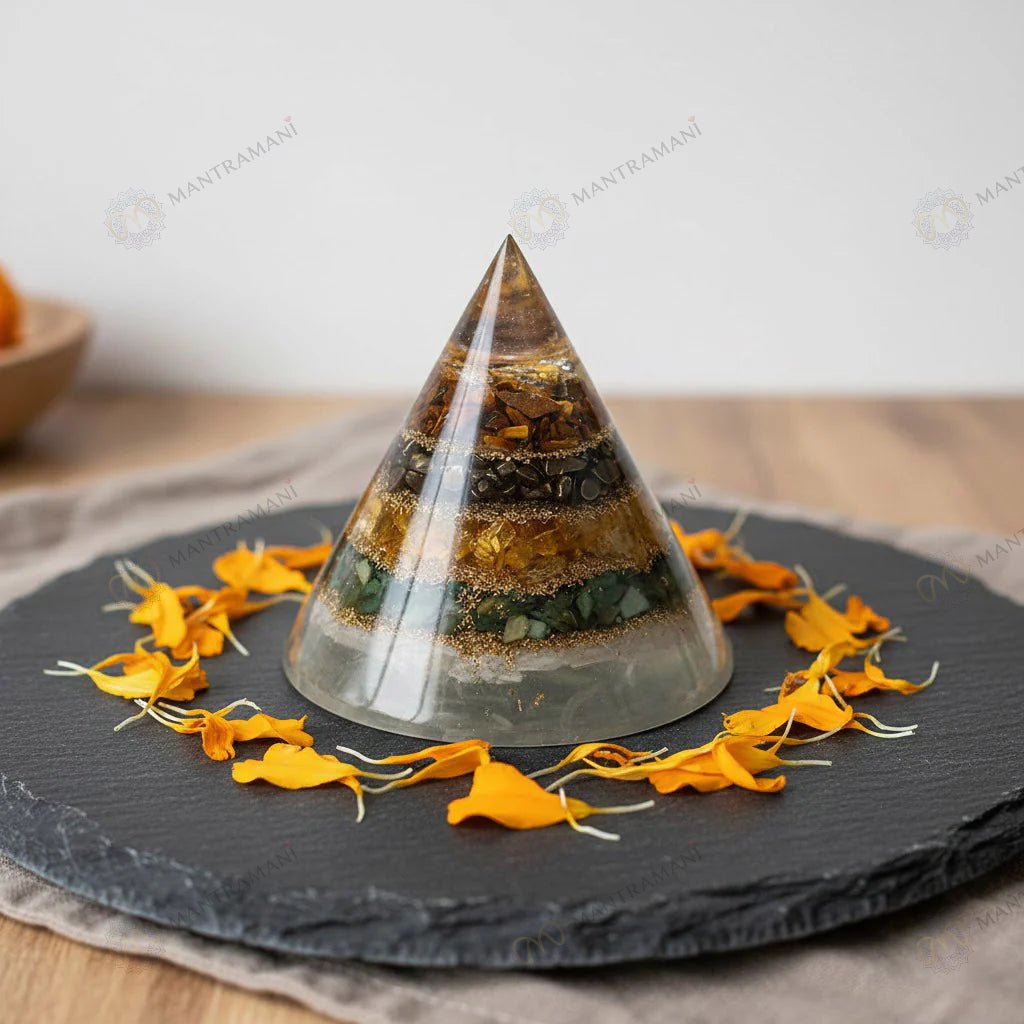
Where pyrite is customarily kept, room by room
A bracelet travels with you; a raw or shaped piece stays put. Placement is the older tradition of the two, and the conventions below are the ones repeated across Vastu practice in India. They are customary placements, not instructions with guaranteed outcomes.
A shop counter or a business cash box
The most common placement of all: a raw cluster or a pyramid kept near where money changes hands, on the counter itself or inside the cash drawer. It should be visible to the person working the counter rather than hidden at the back of a shelf.
An office desk or a cabin
Customarily placed to the left of where you sit as you face the desk, or in the north or north-east corner of the room. A shaped piece works better here than a raw cluster simply because it survives being knocked.
A home entrance
Kept just inside the main door, on a console or shelf at roughly waist height. The convention is that it faces into the home rather than out of it.
A study or a child’s desk
A small tumbled piece rather than a cluster, kept where it will not be picked up and played with. Pyrite is brittle and sheds fine dust when it chips, so it is not a stone to leave within reach of a small child.
A puja shelf
Placed with the other stones rather than at the centre, and taken down and wiped whenever the shelf is cleaned. Keep it away from the oil lamp — heat and soot both mark the surface.
What to avoid everywhere
Bathrooms, kitchen windowsills above a sink, anywhere near a water filter, and any surface that gets wiped with a wet cloth. Damp is the one thing that reliably ruins pyrite, and every one of those places is damp for part of the day.
Care: pyrite tarnishes, and that is chemistry rather than a fault
Keep it dry — this is the whole of the instruction
Remove the bracelet before bathing, swimming, washing up and exercise. Do not rinse it under a tap to cleanse it, whatever a generic crystal-care article tells you; that advice is written for quartz and it is wrong for a sulphide. Wipe it with a dry, soft cloth instead.
What tarnish looks like when it starts
The brassy yellow dulls first, then goes slightly brown, then develops darker patches — usually on the beads that sit against the underside of the wrist, where sweat collects. It is gradual, and it starts sooner in a humid coastal climate than in a dry one.
What to do about dark patches
Wipe firmly with a dry microfibre cloth. Light tarnish lifts. Heavier tarnish will not, and the honest answer is that the surface has reacted and will not come back to factory brightness. A bracelet worn daily for two years in Chennai will not look the way it did in the box, and no seller can promise otherwise.
What never to use
No water, no ultrasonic cleaner, no steam, no lemon, no vinegar, no toothpaste, no metal polish. Acids attack the sulphide directly, abrasives strip the natural lustre and leave the surface grey, and ultrasonic vibration can crack a brittle bead outright.
Where to keep it when you are not wearing it
In the cotton pouch it arrived in, in a drawer, away from the bathroom. Silica gel sachets from a shoebox are genuinely useful here. Do not store it in a sealed plastic bag, which traps whatever humidity was in the air when you closed it.
What moves the price of a pyrite bracelet in India
Pyrite is not a rare mineral, so the price of a bracelet is driven almost entirely by the workmanship and the paperwork rather than by scarcity. Four things move the number.
Bead size and bead count
A 10 mm strand carries roughly twice the mineral of an 8 mm strand of the same length, and is priced accordingly. Count the beads, not the length — a shorter strand at the same price is the commonest quiet downgrade.
Cut quality and matching
Beads drilled straight, sized consistently and finished without chipped edges cost more to produce than beads that are not. Roll the strand across a flat surface: a well-made bracelet rolls evenly, a badly drilled one wobbles.
Whether it is certified, and by whom
A bracelet that ships with an independent gemmological report costs more than one that does not, because someone paid for the test. That is the honest reason, and it is the reason worth paying.
What the seller is willing to stand behind
The cheapest bracelet with no report and no returns is not the same product as a certified one with a written guarantee, even if the beads look identical in a photograph. MantraMani publishes a 10× Authenticity Guarantee: have any item independently tested at a NABL-accredited laboratory of your choosing, and if it is materially different from our report, we refund ten times what you paid and reimburse the testing fee.
Stones commonly worn alongside pyrite
None of these is required, and stacking four bracelets is a fashion decision rather than a traditional one. These are the pairings that come up most often, with the care note that actually differs between them.
| Stone | Traditionally associated with | Care note | Explore |
|---|---|---|---|
| Citrine (Sunela) | Money, business growth, Guru (Jupiter) | Colour fades in strong direct sun — keep it off a sunny sill. | Citrine |
| Tiger Eye | Confidence, focus, Surya (Sun) | Wipe with a dry cloth; the fibres hold water, so do not soak. | Tiger Eye |
| Green Aventurine | Luck, opportunity, Budha (Mercury) | Warm water and a soft cloth; skip ultrasonic cleaners. | Aventurine |
| Green Jade | Prosperity and steady growth | Soap and water only — heat and harsh chemicals dull the polish. | Jade |
| Clear Quartz (Sphatik) | Clarity and amplification | Hard and easy to clean; rinse and dry. | Clear Quartz |
If you are choosing between pyrite and citrine rather than wearing both, that comparison has its own guide: Pyrite vs Citrine for money.
Pyrite by rashi and by ruling planet
In the Vedic reading, pyrite is a fire-and-metal stone associated with Mangal (Mars) and Surya (Sun), which is why it is most often recommended to the fire signs and to the signs whose ruling graha is already strong enough to carry it.
The signs it is most often recommended to
Singh (Leo) and Mesh (Aries) take pyrite most readily — both are fire signs with a strong graha behind them. Dhanu (Sagittarius) is the third of the fire signs and is customarily paired with it for business and travel alike.
The signs usually advised to pair it with something softer
Kark (Cancer) and Meen (Pisces) are water signs, and practitioners commonly suggest wearing pyrite alongside moonstone or clear quartz rather than on its own. This is a customary caution, not a prohibition.
If you do not know your rashi
The rashi in Vedic astrology is the moon sign from the janam kundali, and it is often not the sun sign you know from a newspaper column. The free gemstone finder works it out from a birth date and returns the stone conventionally associated with it.
Common mistakes people make with a pyrite bracelet
Cleansing it under running water
The single most common one, and the most damaging. It comes from generic crystal advice written for quartz. Pyrite is a sulphide; water is exactly what it should not meet.
Wearing it to the gym
Sweat is salty water. A bracelet worn through a daily workout will tarnish in months rather than years.
Buying by photograph alone
Pyrite photographs beautifully and almost every listing image is retouched. The heft test in the section above cannot be done through a screen, which is why the report in the box and a written guarantee matter more here than for most stones.
Stacking it with a soft stone on the same wrist
At 6 to 6.5 on the Mohs scale pyrite is harder than selenite, malachite, turquoise and pearl, and it will scratch all of them as the two strands rub. Put softer stones on the other wrist.
Expecting it to stay mirror-bright
It will not, and a seller who promises it will is either inexperienced or not being straight with you. A worn pyrite bracelet develops a duller, warmer surface over a year or two. That is what the material does.
Frequently Asked Questions
Which hand should I wear a pyrite bracelet on?
Wear it on your right (dominant) hand to project your intention for wealth and success outward.
Can I wear a pyrite bracelet every day?
Yes. Many people wear it daily for ongoing wealth and protection; some prefer to remove it before sleeping.
Can a pyrite bracelet get wet?
Avoid water — pyrite contains iron and can rust. Remove it before bathing or swimming, and cleanse with sunlight or a selenite plate instead.
How long until I see results?
Many wearers notice shifts in confidence and opportunity within a few weeks of consistent daily wear combined with focused effort.
How do I know my pyrite is real?
Genuine pyrite is heavy, metallic and cool to touch with a brassy gold shine and natural variation. Always buy lab-certified natural pyrite with a Certificate of Authenticity.
What bead size should I choose, 8 mm or 10 mm?
Choose 8 mm if you want the bracelet to sit flat under a shirt cuff or if your wrist measures under 16 cm, and 10 mm if you want the piece to be visible and you have a wrist of 17 cm or more. Pyrite is dense, so a 10 mm strand is noticeably heavier by the end of a day.
How do I size a pyrite bracelet correctly?
Wrap a strip of paper around the wrist just below the wrist bone, mark the overlap and measure it flat. Add about 1.5 cm for an 8 mm strand and about 2 cm for a 10 mm strand. Larger beads need more slack because the cord has to travel around the outside of each bead.
Why has my pyrite gone dark or brown?
Pyrite is iron sulphide, and it reacts with moisture and air. Dark patches usually appear first on the beads that sit against the underside of the wrist, where sweat collects. Light tarnish lifts with a dry microfibre cloth; heavier tarnish is permanent, and it happens faster in a humid coastal climate.
Can I clean a pyrite bracelet with water or an ultrasonic cleaner?
No to both. Water is what causes the tarnish in the first place, and an ultrasonic cleaner can crack a brittle bead outright. Use a dry, soft cloth. Never use lemon, vinegar, toothpaste or metal polish — acids attack the sulphide and abrasives strip the lustre.
What does AAA grade pyrite mean?
Nothing standardised. There is no recognised colour, clarity or cut grading system for pyrite the way there is for sapphire, so AAA is a supplier’s own label and means whatever that supplier decides it means. A gemmological report that names the species, the weight and any treatment is the document worth having.
Is pyrite safe to wear against the skin?
Polished pyrite beads are worn daily by a great many people without incident. Wash your hands after handling raw or freshly broken pyrite, since chipping it releases fine dust, and keep raw pieces away from small children — it is brittle and it sheds when knocked.
Can I wear pyrite with turquoise, selenite or pearl on the same wrist?
Better not to. Pyrite sits at 6 to 6.5 on the Mohs scale, which makes it harder than turquoise, selenite, malachite and pearl, and the two strands will rub all day. Put softer stones on the other wrist.
Which rashi can wear pyrite?
Pyrite is associated with Mangal (Mars) and Surya (Sun), so it is most often recommended to the fire signs — Mesh (Aries), Singh (Leo) and Dhanu (Sagittarius). Practitioners commonly suggest that Kark (Cancer) and Meen (Pisces) natives pair it with moonstone or clear quartz rather than wearing it alone.