













Clear Quartz (Sphatik) Benefits & How to Wear
Clear quartz — known across India as sphatik — is the crystal most often called the “master healer” or “master amplifier”. In crystal tradition it is not worn for one narrow purpose the way carnelian or pyrite are; it is worn to clarify and strengthen whatever intention you set with it, which is why it appears in almost every combination bracelet and in the sphatik malas used for japa. Here is what sphatik is, what it is traditionally associated with, who wears it, and how to tell a real one from the glass copies that fill the Indian market.
Clear quartz: quick facts
| Also called | Sphatik, rock crystal, the Master Healer |
| Mineral | Silicon dioxide, the purest form of quartz |
| Traditionally worn for | Clarity of mind, focus, meditation, amplifying intention |
| Chakra | Crown (Sahasrara); regarded as an all-chakra amplifier |
| Planet (Vedic) | Shukra (Venus) — accepted as an upratna substitute for heera (diamond) |
| Hardness | 7 on the Mohs scale — durable enough for daily wear |
| Wear on | Either hand; left to receive, right to project |
| Water safe | Yes |
What clear quartz is and where it comes from
Clear quartz is pure crystalline silicon dioxide. When quartz grows slowly in a cavity with no colouring impurities present, it forms the transparent, glass-clear crystal we call rock crystal, or sphatik. Add trace iron and the same mineral becomes amethyst or citrine; add fine titanium needles and it becomes rutilated quartz. Sphatik is the parent stone of that entire family.
India is itself a genuine source. Quartz is mined in the Himalayan belt of Himachal Pradesh and Uttarakhand, and in the granite and pegmatite country of Andhra Pradesh, Telangana, Rajasthan and Karnataka. Himalayan sphatik carries particular prestige in the Indian spiritual market because of its association with Shiva — a sphatik Shivling or a sphatik mala said to come from the Himalayas is treated as an especially auspicious object. Beyond India, the best-known clear quartz on the world market comes from Minas Gerais in Brazil, from Madagascar, and from Arkansas in the United States.
Grades differ enormously. Cloudy, veiled, milky material is abundant and cheap. Fully transparent, colourless, inclusion-free sphatik in a decent size is genuinely uncommon, and that gap between the two is the single biggest driver of price.
Traditional associations: Vedic, planetary and chakra
In Vedic gemmology, sphatik is grouped under Shukra (Venus) and is the most widely accepted upratna, or substitute stone, for heera (diamond). Astrologers recommend it where a diamond has been prescribed but is out of reach, and it is regarded as one of the very few stones that may be worn without a strict chart reading — practitioners describe it as neutral and non-aggravating rather than sharply planet-specific in the way neelam or manik are said to be. If you want the framework behind how substitute stones get chosen at all, our rashi ratan buying guide sets it out.
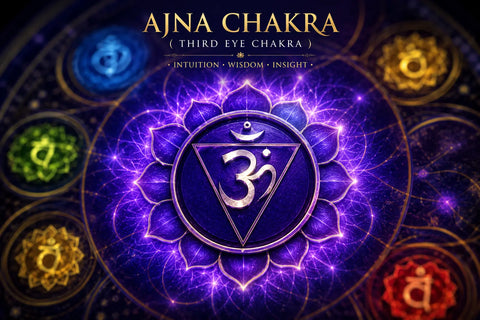
In chakra practice, clear quartz is assigned to the crown chakra, Sahasrara, and is described as the meeting point between individual awareness and something larger. It is also the one crystal used across all seven centres, because tradition holds that it takes on and amplifies the quality of whatever it is paired with — which is why it anchors almost every seven chakra design. Our guide to chakra healing stones explains how the seven centres map to colour.
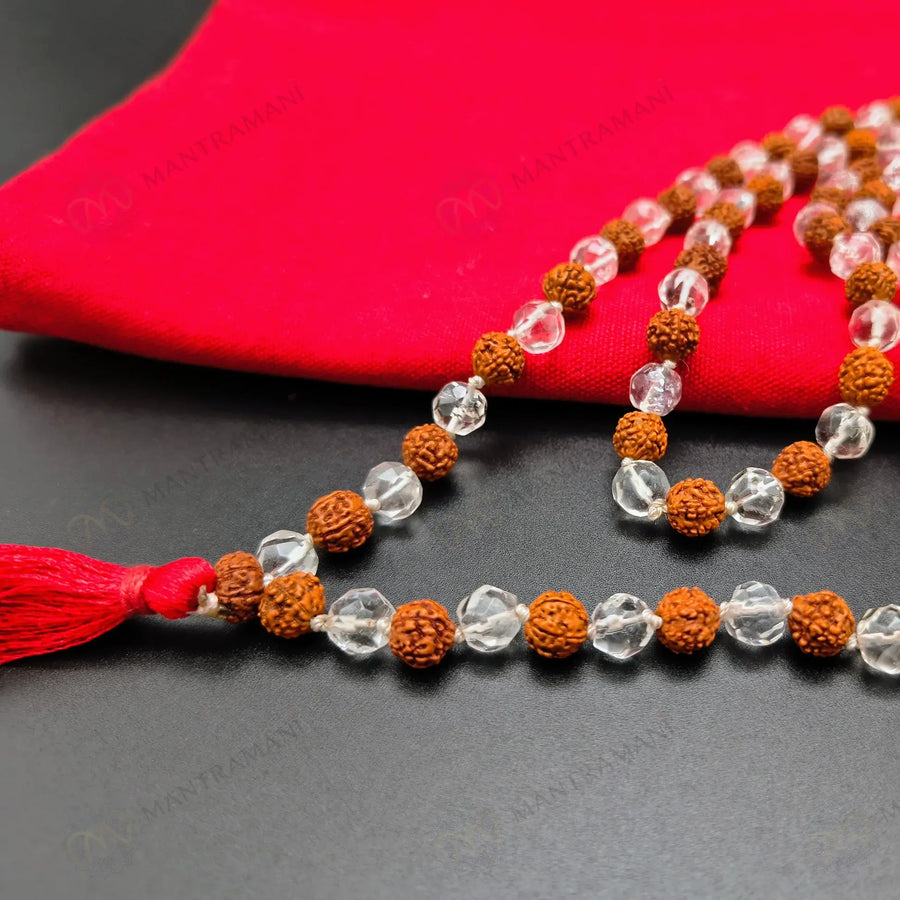
In Shaiva tradition, sphatik has a devotional life of its own, quite separate from the Western “master healer” framing. The sphatik mala is one of the classic rosaries for japa and for mantras to Shiva, and sphatik Shivlings are kept on home altars across India. This is an Indian use of the stone with centuries behind it.
What clear quartz is traditionally worn for
Crystal practitioners regard clear quartz as an amplifier rather than a specialist. It is traditionally worn for:
- Clarity of thought — the association that gives the stone its name, and the reason people reach for it when a decision feels muddled.
- Focus and study — widely used by students and by anyone doing sustained mental work.
- Meditation — the sphatik mala is among the most traditional japa malas in India.
- Amplifying intention — in crystal tradition it is believed to strengthen the qualities of the stones worn beside it, which is why combination bracelets so often include it.
- Cleansing a space — sphatik points and clusters are traditionally kept in rooms and on altars as a purifying presence.
These are traditional and spiritual associations. They are not medical claims, and no crystal is a substitute for professional advice.
Who traditionally wears clear quartz
Sphatik is one of the few stones described in Indian practice as suitable for everyone, whatever the rashi. That said, astrologers most often recommend it for:
- Vrishabha (Taurus) and Tula (Libra) — both ruled by Shukra, the planet sphatik is said to carry.
- Anyone for whom a diamond has been prescribed but is impractical, since sphatik is the standard upratna.
- Students, writers, teachers and anyone in sustained mental work, for its clarity association.
- Beginners to crystals, because it is regarded as gentle, neutral and difficult to get wrong.
- Anyone building a combination bracelet, since it is the traditional amplifier stone.
If you would rather start from your own rashi, our gemstone for your rashi guide is the place to begin.
How to wear and care for clear quartz
Which hand. In crystal tradition the left side receives and the right side projects. Wear sphatik on the left when you want clarity to come to you, on the right when you want to carry it outward into work or conversation. For a sphatik mala, use the right hand for japa, rolling the beads with the thumb over the middle finger, and turn back at the sumeru bead rather than crossing it.
When to start. Astrologers who treat sphatik as a Venus stone suggest beginning on a Friday morning, after cleansing the stone and setting an intention. This is optional — sphatik is not held to demand the strict muhurta that the navaratna stones do.
Metal. Silver is the traditional setting for Venus stones and suits sphatik’s colourless clarity. White gold and platinum work equally well.
Cleansing. Clear quartz is water-safe and hard enough for running water. Rinse it, leave it out in moonlight overnight, or rest it on a selenite plate. Repeat every couple of weeks, more often if you wear it daily.
Care. At Mohs 7 it resists everyday scratches, but keep it away from perfume, chlorinated pool water and sudden temperature changes, which can worsen an existing internal fracture. Store it in a soft pouch, apart from harder stones.
Real vs fake clear quartz: how to identify authentic sphatik
Clear quartz is imitated more than almost any other crystal, simply because ordinary glass looks similar to an untrained eye. Practical checks:
- Bubbles. Glass traps round air bubbles; natural quartz does not. Perfectly round bubbles are the single clearest sign of glass.
- Temperature. Quartz draws heat away from the skin and stays noticeably cool for several seconds when you pick it up. Glass and plastic reach hand temperature almost at once.
- Too perfect is a warning. Genuine sphatik usually shows some internal character — a faint veil, a hairline, a small inclusion. Flawless, uniform, perfectly matched beads at a low price are usually moulded glass.
- Scratch resistance. Quartz at Mohs 7 will not be scratched by a steel blade. Glass, at roughly 5.5, will be.
- Weight. Quartz feels denser in the hand than a same-sized piece of plastic or resin.
- Bead-to-bead variation. In a strand of natural sphatik, no two beads have identical internal patterns. Identical beads mean moulded material.
Every MantraMani sphatik piece is natural stone, independently tested by a government-approved, ISO 9001:2015 certified gemmological laboratory, and cleansed and energised with a Vedic ritual before dispatch.
Clear quartz price in India: what actually drives cost
Sphatik spans an unusually wide price range, because two very different products share the name.
Crystal-format sphatik — bracelets, pendants, pyramids, keychains and malas — typically sits in the few-hundred to low-thousands rupee band. What moves the price within that band:
- Transparency. Milky or cloudy quartz is the cheapest material on the market. Genuinely water-clear beads cost several times more.
- Bead size and matching. An 8mm or 10mm strand in which every bead is cut clear and matched consumes far more rough than a mixed-clarity strand.
- Format and labour. A hand-knotted 108-bead mala is far more work than a stretch bracelet. Carved pyramids, spheres and Shivlings are priced on carving time and on how much clear rough had to be cut away.
- Origin. Himalayan sphatik carries a premium in India for devotional use.
Certified loose sphatik, sold per carat as a Venus upratna, is a different market altogether and reaches into the tens of thousands of rupees for large, flawless, well-cut stones. Here the drivers are the classic four: colour (a complete absence of tint), clarity (eye-clean to loupe-clean), cut precision, and carat weight — with price per carat climbing sharply as size increases, because clean large rough is scarce.
Treat very cheap “crystal” bracelets sold in bulk with scepticism. At the bottom of that market, glass is the norm rather than the exception. Current prices for every format sit on the clear quartz collection page.
Frequently asked questions
What are the benefits of clear quartz?
In crystal tradition clear quartz is regarded as the master amplifier. It is traditionally worn for clarity of thought, focus, meditation, and for strengthening the intention behind whatever other stones it is paired with. In Vedic astrology it is associated with Shukra (Venus) and used as a substitute for diamond. These are traditional beliefs rather than proven effects.
Who can wear sphatik?
Sphatik is one of the few stones described in Indian practice as suitable for anyone, without a strict chart reading. It is most often recommended for Vrishabha (Taurus) and Tula (Libra), which are Venus-ruled, and for anyone advised to wear a diamond who wants an affordable substitute.
Which hand should I wear clear quartz on?
The left hand to receive clarity, the right to carry it outward. A sphatik japa mala is traditionally held in the right hand.
Is sphatik the same as clear quartz?
Yes. Sphatik is the Sanskrit and common Indian name for natural clear quartz, also called rock crystal. The names describe the same mineral.
How do I know if my sphatik is real or glass?
Look for round air bubbles, which mean glass. Real quartz stays cool for several seconds in the hand, resists a steel scratch, and shows small natural differences between beads. Flawless, identical, cheap beads are the classic sign of moulded glass.
Can clear quartz go in water?
Yes. Clear quartz is water-safe and can be rinsed under running water. Avoid very hot water and sudden temperature changes if the stone has a visible internal fracture.
Which stones pair well with clear quartz?
Almost all of them — that is the point of an amplifier. The most common Indian pairings are sphatik with amethyst for calm, with rose quartz for the heart, and with rudraksha for devotional wear.
✨ Bring clarity and focus into daily wear with MantraMani’s natural sphatik — independently tested by a government-approved, ISO 9001:2015 certified gemmological laboratory, cleansed with a Vedic ritual, with free shipping across India. Shop the Clear Quartz collection →
Also explore: Sphatik & rudraksha malas · Crystals for clarity · Crystals for meditation
Written by the MantraMani team — specialists in authentic, AAA-grade natural Vedic gemstones and healing crystals. This guide is for spiritual and informational purposes.
Disclaimer: MantraMani’s gemstones, crystals and rudraksha are spiritual products offered in the Vedic tradition. Benefits described — for wealth, relationships, calm, focus, protection, well-being and similar — reflect traditional beliefs and are not scientifically or medically proven. These products are not a substitute for professional medical, psychological, legal or financial advice, diagnosis or treatment. Individual experiences vary. For any health condition, please consult a qualified professional.