









Rudraksha Mukhi Guide: 1 to 14 Mukhi Meanings, Benefits & Who Should Wear
“Mukhi” means the number of natural faces (clefts) running down a rudraksha bead, from 1 to 21, and each mukhi is traditionally linked to a specific deity, a ruling planet and a purpose. The everyday 5 mukhi (Jupiter) is worn for calm and clarity; the rare 1 mukhi (Sun) for focus and consciousness; the 7 mukhi (Saturn) for prosperity and relief from Shani troubles. This guide gives you the full 1–14 mukhi chart — deity, planet and who traditionally wears each — so you can choose the right bead, then verify it is genuine and lab-certified before you buy.
What does “mukhi” mean in rudraksha?
Rudraksha is the dried seed of the Elaeocarpus ganitrus tree, grown mainly in Indonesia (Java), Nepal and parts of India. The name joins the Sanskrit Rudra (Lord Shiva) and aksha (eye or teardrop) — often translated as “the tears of Shiva.” Every bead is marked by natural vertical lines or clefts called mukhi (Hindi/Sanskrit: mukh = face). Count the lines that run unbroken from the top hole to the bottom and you have the mukhi number. A bead with five lines is a 5 mukhi; one with a single continuous line is a 1 mukhi.
In Vedic tradition, the mukhi count is not just a physical feature — it is believed to determine the bead’s ruling deity, its governing planet (graha), and the area of life it supports. This is why rudraksha is often chosen the way a rashi-ratna (astrological gemstone) is: to balance a particular planet in one’s chart. Higher-mukhi and rare beads (1, 14, 21 mukhi) are the most valuable, which is also why the market is full of fakes carved from betel nut or wood.
Rudraksha mukhi chart: 1 to 14 mukhi at a glance
The table below maps each mukhi to its traditional ruling deity, associated planet and the purpose it is worn for. Associations are drawn from classical rudraksha lore and vary slightly between traditions — treat them as belief, not prescription.
| Mukhi (faces) | Ruling deity | Associated planet (graha) | Traditionally worn for |
|---|---|---|---|
| 1 Mukhi | Lord Shiva | Sun (Surya) | Focus, leadership, higher consciousness, detachment |
| 2 Mukhi | Ardhanareeshwara (Shiva-Shakti) | Moon (Chandra) | Unity, relationships, emotional balance, harmony |
| 3 Mukhi | Agni (fire) | Mars (Mangal) | Confidence, releasing past guilt, self-esteem, energy |
| 4 Mukhi | Brahma | Mercury (Budh) | Learning, memory, creativity, clear speech |
| 5 Mukhi | Kalagni Rudra (Shiva) | Jupiter (Guru / Brihaspati) | Calm, clarity, wellbeing — the most common bead |
| 6 Mukhi | Kartikeya (Murugan) | Venus (Shukra) | Willpower, grounding, charm, emotional steadiness |
| 7 Mukhi | Goddess Mahalakshmi | Saturn (Shani) | Prosperity, relief from Shani dosha, steadiness |
| 8 Mukhi | Lord Ganesha | Rahu | Removing obstacles, success in new ventures |
| 9 Mukhi | Goddess Durga (Shakti) | Ketu | Fearlessness, energy, protection, courage |
| 10 Mukhi | Lord Vishnu | No single planet (acts as a shield) | Protection from negativity, peace, harmony |
| 11 Mukhi | Lord Hanuman | No single planet (all grahas) | Courage, wisdom, willpower, adventure |
| 12 Mukhi | Surya (Aditya) | Sun (Surya) | Radiance, vitality, leadership, self-assurance |
| 13 Mukhi | Kamadeva / Indra | Venus (Shukra) | Charm, attraction, fulfilment of wishes |
| 14 Mukhi (Dev Mani) | Lord Hanuman / Shiva | Saturn (Shani) | Intuition, decision-making, the “third eye,” protection |
You can see all of these in one place in our lab-certified, energized rudraksha collection, available as single beads or ready-strung in the mala & japa collection.
The most-worn mukhi, explained
1 Mukhi Rudraksha — the rarest, ruled by the Sun
The 1 mukhi rudraksha is the most prized and hardest to find in a true round form (the half-moon “kaju” shape from South India is more common). Ruled by Lord Shiva and the Sun, it is traditionally associated with single-pointed focus, leadership and inner detachment. Because genuine round 1 mukhi beads are extremely rare and costly, this is the mukhi most often imitated — never buy one without X-ray and lab documentation.
5 Mukhi Rudraksha — the everyday bead of Jupiter
The 5 mukhi is by far the most common and the safest starting point. Governed by Kalagni Rudra (Shiva) and the planet Jupiter (Guru), it is worn for calm, clarity and general wellbeing, and is the bead most 108-bead japa malas are made from. If you are new to rudraksha, a 5 mukhi mala or bracelet is the traditional first choice.
7 & 14 Mukhi Rudraksha — the beads of Saturn (Shani)
Both the 7 mukhi (ruled by Goddess Mahalakshmi) and the 14 mukhi or “Dev Mani” (ruled by Hanuman) are traditionally connected to Saturn (Shani). They are often chosen by those going through Shani’s major periods (Sade Sati or Dhaiya) to steady the mind and support prosperity. If you are exploring remedies for Saturn specifically, browse our Shani (Saturn) remedy collection alongside these beads.
9, 10 & 11 Mukhi Rudraksha — protection and courage
The 9 mukhi (Durga / Ketu), 10 mukhi (Vishnu) and 11 mukhi (Hanuman) are the classic protective and courage-giving beads. The 10 mukhi in particular is described in tradition as a shield that is not tied to any single planet, worn to ward off negativity. If protection is your main intention, you can also explore stone-based options in our protection collection.
Which mukhi rudraksha should you wear?
There are two traditional approaches. The first is by intention: pick the mukhi whose purpose matches your goal — 5 mukhi for calm, 7 mukhi for prosperity, 9/10 mukhi for protection, 6 mukhi for confidence. The second is by planet: if a Vedic astrologer has identified a weak or troublesome planet in your chart, choose the mukhi that governs it (for example, a 4 mukhi to support Mercury, or a 7 mukhi for Saturn). Many people simply wear a 5 mukhi mala as a universally safe, everyday bead that suits all rashis.
A few traditional points worth knowing:
- Single bead vs mala. A single powerful bead (say 1, 7 or 14 mukhi) is usually capped and worn as a pendant; 5 mukhi beads are strung into 27, 54 or 108-bead malas for japa (mantra repetition).
- Combinations. Some wear a siddha mala combining several mukhi (1 to 14) for all-round balance; this should be assembled by someone who understands the associations.
- Material choice. If you like the sacred-bead form but want a different material, karungali (ebony) malas are a traditional South Indian alternative worn for grounding and protection.
How to wear and care for rudraksha
Rudraksha is traditionally worn against the skin, on a red or black thread, silver, or gold cap. Common conventions:
- When to start. Many begin on a Monday (Shiva’s day) after the bead has been abhimantrit (energized) with the appropriate mantra — for example, Om Namah Shivaya for a 5 mukhi.
- Keep it clean and oiled. Wipe occasionally and lightly oil the beads once in a while to prevent drying and cracking. Avoid harsh chemicals and prolonged soaking.
- It is personal. In tradition, an energized rudraksha is not shared or worn by others once it is yours.
What a rudraksha bead actually is
A rudraksha is the stone of a fruit, not a mineral and not a wooden bead. It comes from Elaeocarpus ganitrus, a tall evergreen that grows through the Himalayan foothills and across parts of Indonesia. The fruit is blue when ripe; the hard seed inside it, once the flesh is removed and dried, is the bead. The ridges running from crown to base are natural sutures, and the number of them is the mukhi.
Where rudraksha comes from
Three origins account for almost everything on the market. Nepal — chiefly the eastern districts — produces the largest beads with the deepest, most clearly separated ridges. Indonesia, mainly Java, produces small, smooth, dense beads. India grows a smaller quantity, largely in the north-east and in parts of Karnataka and Tamil Nadu.
Nepali and Indonesian beads: how to tell them apart
Size is the first tell. Indonesian 5 mukhi beads commonly measure 6 to 12 mm; Nepali 5 mukhi beads commonly measure 18 to 25 mm and can be larger. Nepali beads have deeper valleys between the ridges and a rougher, more sculpted surface; Indonesian beads are smoother and rounder, and their ridges can be shallow enough that counting them needs good light. Neither is fake. Nepali beads cost more because they are larger and scarcer, not because they are a different species.
How rudraksha is measured and priced
Beads are sold by diameter in millimetres and, for larger single beads, by weight. Price rises steeply with mukhi rarity rather than with size: 5 mukhi is the most abundant face count and the cheapest, while 1, 14 and 21 mukhi are genuinely rare and priced accordingly. Within a mukhi, a larger, well-formed, undamaged Nepali bead commands a multiple of a small Indonesian one.
Five checks you can run before you buy
1. Count the ridges twice, in daylight
Follow each suture with a fingernail from the crown of the bead to the base. A ridge has to run the whole way to count. Shallow scratches that fade halfway are not mukhis, and this is where most miscounts and most overcharging happen.
2. Look at the natural hole
A rudraksha has a natural cavity through its centre. A drilled hole is round, straight-sided and identical on both faces. A natural passage is irregular and rarely perfectly centred. A drilled bead is not automatically fake — many genuine beads are drilled to widen the passage for stringing — but a perfectly round hole on a bead sold as untouched is a contradiction.
3. Check whether the ridges look carved
The commonest fake is a genuine low-mukhi bead with extra grooves cut into it to raise the count. Carved grooves have sharp, even, machine-consistent walls and often show tool marks at the ends. Natural sutures are irregular, they wander, and their depth varies along their length.
4. Look for a joined bead
The other common fake is two half-beads glued together to make a high-mukhi bead. Examine the widest part of the bead under a bright light for a seam running all the way round. Glue lines catch the light differently from the seed surface, and often show a hairline of filler.
5. Be suspicious of a cheap high mukhi
A 14 mukhi at the price of a 5 mukhi is not a bargain. This is the same rule that governs every other stone: flawless and cheap together is the signal, and no other test is needed to read it.
What a fake rudraksha usually is
Not usually plastic. The three common frauds, in order, are a carved bead with added grooves, two halves joined to fake a rare count, and an ordinary betel nut or wooden bead shaped and stained to look the part. The last is the easiest to spot: it is too light, too uniform, and it has no natural hole.
The water test, and why it proves less than people think
The old test says a genuine bead sinks in water and a fake floats. It is unreliable in both directions. Density varies with how dry the bead is and with the size of the internal cavity, so genuine beads can float and dense fakes can sink. Treat a sink as weak supporting evidence and never as proof — and soaking a bead is not good for it either way.
How to buy genuine, lab-certified rudraksha
Because rare-mukhi beads carry a premium, authenticity is everything. The single most reliable check is an X-ray: inside a genuine bead the number of internal seed compartments (loculi) should equal the number of mukhi lines on the outside. Reputable sellers back this with a lab certificate stating the mukhi count and origin (Java beads are smaller and smoother; Nepali beads larger and more pronounced). Before you pay, insist on:
- X-ray / lab certification of the mukhi count, especially for anything above 5 mukhi.
- Natural, untreated beads with disclosed origin.
- Energization (pran-pratishtha / abhimantrit) before dispatch, in keeping with tradition.
- A clear return/verification window so you can inspect on arrival.
For the step-by-step authenticity tests — mukhi lines, surface texture, the X-ray method, and why the water and coin “tests” are myths — read our companion guide: How to Identify Original Rudraksha: The Complete Authenticity Guide. At MantraMani, every bead in the rudraksha collection is sold as a natural, lab-certified and energized bead with authenticity documentation.
What a rudraksha lab report tells you
An independent report on a rudraksha bead should state the species, the mukhi count, the diameter, and whether the bead has been altered — carved, joined, dyed or oiled. That is the whole of the useful content, and the mukhi count is the line that matters, because it is the number the price is built on. Every MantraMani order ships with a report from a government-approved, ISO 9001:2015 certified gemmological laboratory, and the certificate number is printed on the box.
The mukhi claim is also the one covered by MantraMani’s 10× Authenticity Guarantee: if an independent NABL-accredited laboratory of your choosing finds the bead is a different mukhi count or a different species from our report, or that it has been carved or joined, we refund ten times what you paid and reimburse the testing fee.
Rudraksha and the nine grahas
The standard mapping used across Jyotish practice runs as follows. It is a traditional association, and practitioners differ at the edges.
| Mukhi | Graha | Traditionally worn for |
|---|---|---|
| 1 | Surya (Sun) | Authority, clarity of purpose |
| 2 | Chandra (Moon) | Harmony between two people |
| 3 | Mangal (Mars) | Release from the past, courage |
| 4 | Budha (Mercury) | Study, speech, memory |
| 5 | Guru (Jupiter) | The everyday bead — calm, learning |
| 6 | Shukra (Venus) | Expression, relationships |
| 7 | Shani (Saturn) | Sade Sati and Shani periods |
| 8 | Ketu | Obstacles, beginnings |
| 9 | Rahu | Fearlessness, energy |
Rudraksha mala: 108+1, 54+1 and 27+1
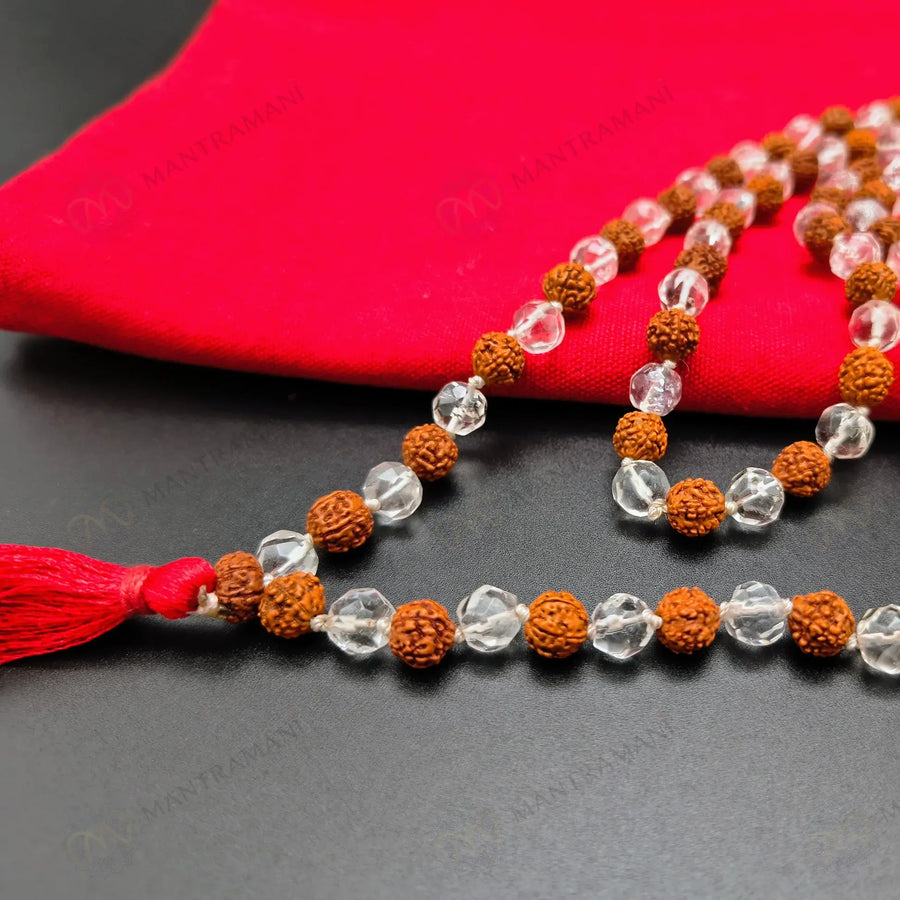
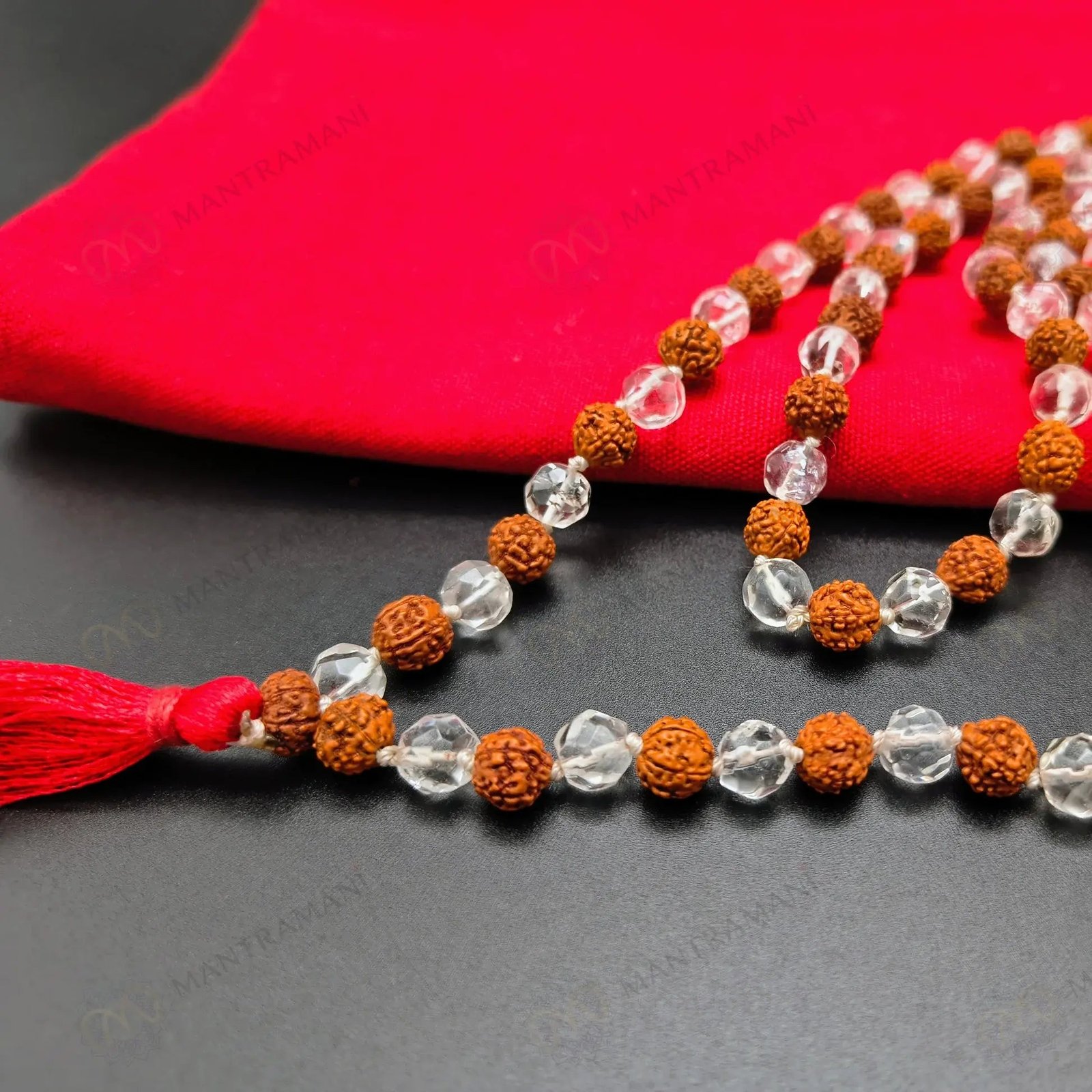
A japa mala is 108 beads plus one, the extra bead being the sumeru or Guru bead that marks the start and end of a round. It is never counted or crossed — you reverse direction at the sumeru rather than passing over it. A 54+1 mala is half a round and a 27+1 is a quarter, both used when a full 108 is impractical. A wrist mala is usually 27+1.
Stringing: thread, silver or gold
Traditional stringing is red or black cotton or silk thread, knotted between beads so the mala keeps its spacing and does not scatter if the thread parts. Silver and gold caps are common on single beads and on higher-value malas; they protect the bead’s crown and base, which are the parts that chip. Avoid steel wire, which saws into the seed over time, and avoid elastic on a full 108 mala, where the weight will defeat it within a year.
Wearing rules people actually ask about
Rudraksha is customarily worn against the skin rather than over clothing, and is normally started on a Monday or on a Shivaratri after being dipped in water and ghee and energised with the appropriate mantra. Practitioners commonly advise removing it during cremation rites and before intimacy. There is no rule requiring vegetarianism, whatever a seller may imply.
When not to wear rudraksha
Remove it before swimming, before a shower with shampoo or soap, and before applying oil or perfume to the neck and wrists. Take it off before an MRI, along with everything else. If a bead has cracked through a ridge, stop wearing it — a cracked bead is customarily retired rather than repaired.
Care and cleaning through the year
Wipe with a dry cloth after wearing. Every few months, oil the beads lightly with mustard, sesame or olive oil, work it in with the fingers and wipe off the excess — this keeps the seed from drying out and cracking, which is the commonest way a genuine bead is lost. Do not soak a rudraksha overnight, do not put it in an ultrasonic cleaner and do not leave it in direct sun on a windowsill.
What ships in the box at MantraMani
Every rudraksha order arrives with a gemmological report naming the species and the mukhi count, the certificate number printed on the box, the bead energised following traditional procedure before sealing, and a cotton pouch. Shipping is free on every order to every PIN code with no minimum; Cash on Delivery is a flat ₹49 and prepaid orders take a flat 5% off automatically.
Frequently asked questions
What does mukhi mean in rudraksha?
Mukhi means “face” — the number of natural vertical lines or clefts running down a rudraksha bead from top to bottom. A bead with five such lines is a 5 mukhi, one with seven is a 7 mukhi, and so on, from 1 up to 21. Each mukhi is traditionally linked to a deity, a ruling planet and a specific purpose.
Which mukhi rudraksha is best for beginners?
The 5 mukhi rudraksha is the best starting point. It is the most common, the most affordable, is associated with Jupiter (Guru) and Lord Shiva, and is considered safe for everyone regardless of rashi. Most 108-bead japa malas are made from 5 mukhi beads.
Which rudraksha is worn for Saturn (Shani)?
The 7 mukhi (Goddess Mahalakshmi) and the 14 mukhi or Dev Mani (Hanuman) are both traditionally associated with Saturn (Shani) and are chosen by those going through Sade Sati or Shani’s major periods. Some traditions also link the blue-sapphire planet Saturn to specific stone remedies alongside these beads.
How do I know if a rudraksha is real?
The most dependable test is an X-ray: the internal seed compartments should equal the number of mukhi lines outside. Pair this with a lab certificate, natural continuous mukhi lines, and a hard, knobbly, woody surface. Popular water “float or sink” and copper-coin tests are traditional beliefs, not reliable proof.
Can I wear more than one mukhi rudraksha together?
Yes. Many wear a siddha mala that combines several mukhi (commonly 1 to 14) for all-round balance, or pair a purpose-specific bead with a 5 mukhi mala. It is best to have such combinations assembled by someone who understands the traditional deity and planet associations.
Should rudraksha be energized before wearing?
In tradition, many prefer a rudraksha that has been energized (pran-pratishtha / abhimantrit) with the appropriate mantra before first wear. This is a belief-based ritual rather than a quality test, so still confirm the bead itself is genuine and, ideally, X-ray or lab certified.
Shop lab-certified Rudraksha → · Which gemstone for your rashi? →
Gemstone & astrological guidance reflects traditional Vedic beliefs and is for spiritual/wellness purposes only — it is not medical, legal or financial advice, and MantraMani products are not intended to diagnose, treat, cure or prevent any disease.
What is the difference between Nepali and Indonesian rudraksha?
Both are the same species. Nepali beads are much larger — a 5 mukhi commonly measures 18 to 25 mm against 6 to 12 mm for Indonesian — with deeper, more clearly separated ridges and a rougher surface. Indonesian beads are smoother, rounder and denser. Nepali beads cost more because they are bigger and scarcer, not because Indonesian beads are inferior.
Does a real rudraksha sink in water?
Usually, but the test proves very little. Density varies with how dry the bead is and with the size of its internal cavity, so genuine beads sometimes float and dense fakes sometimes sink. Treat it as weak supporting evidence, never as proof — and soaking a bead is not good for it in any case.
How do I spot a carved or joined rudraksha?
Carved grooves have sharp, even, machine-consistent walls and often show tool marks where they end, while natural sutures wander and vary in depth. A joined bead shows a hairline seam running right around its widest part, sometimes with visible filler. Both frauds exist to raise the apparent mukhi count, so check hardest on high-mukhi beads.
Should a rudraksha be oiled, and with what?
Yes, every few months. Mustard, sesame or olive oil, worked in with the fingers and the excess wiped off. It keeps the seed from drying out and cracking, which is the commonest way a genuine bead is lost. Do not soak it overnight.
Why is 5 mukhi rudraksha so much cheaper than the others?
Because it is by far the most abundant. Price in rudraksha tracks rarity of the face count rather than size or beauty, so 5 mukhi is the everyday bead and 1, 14 and 21 mukhi are genuinely scarce. A 14 mukhi offered at 5 mukhi prices is the clearest warning sign in the trade.
What is the sumeru bead on a mala?
The extra bead on a 108+1, 54+1 or 27+1 mala, also called the Guru bead. It marks the start and end of a round and is never counted or crossed — you reverse direction at the sumeru rather than passing over it.
Can I wear a cracked rudraksha?
A bead cracked through a ridge is customarily retired rather than repaired or worn on. Small surface marks and natural pits are not cracks and are normal on a genuine bead.