





Hematite Benefits, Its Mantra & How to Wear It
Hematite is iron ore — literally. It is the heaviest-feeling stone most people ever hold at bracelet size, and that weight is the whole point of it. In crystal practice it is the grounding stone: the one worn when the mind will not settle. This guide covers what it is traditionally associated with, the mantras chanted with it, and how to spot the magnetic imitation that dominates the cheap end of the market.
Hematite: quick facts
| Also called | Ratnaraj Loha, Bloodstone (confusingly — it is not the same as heliotrope), Haematite |
| Mineral | Iron oxide. Metallic grey-black, and unusually heavy for its size |
| Traditionally worn for | Grounding, focus, steadiness, protection |
| Chakra | Root (Muladhara) |
| Planet | Contested — see below. Commonly Mangal (Mars) for its iron; Shani (Saturn) in Indian retail practice |
| Typical price | ₹749 for a bracelet or anklet |
The mantra for hematite
This is the question we are asked most often about this stone, and it deserves a straight answer rather than an invented one.
Hematite is not a classical Vedic ratna. It is not one of the navratna, and it therefore has no beej mantra of its own in the traditional texts — anyone who tells you otherwise is improvising. What is actually chanted with it is the beej mantra of the planet it is associated with, and practice is split on which planet that is:
- Mangal (Mars) — the older association, on the basis that hematite is iron and iron is Mars’s metal. Chanted for courage, drive and physical steadiness.
- Shani (Saturn) — the association more common among Indian sellers, on the basis of its colour, weight and grounding quality. Chanted for patience, discipline and endurance.
Use the one that matches your intention. Both are given here in full.
Mangal (Mars) beej mantra
ॐ क्रां क्रीं क्रौं सः भौमाय नमः
Om Kraam Kreem Kraum Sah Bhaumaya Namah
Traditionally chanted 108 times, on a Tuesday, facing east.
Shani (Saturn) beej mantra
ॐ प्रां प्रीं प्रौं सः शनैश्चराय नमः
Om Praam Preem Praum Sah Shanaishcharaya Namah
Traditionally chanted 108 times, on a Saturday, facing west.
If you do not chant
A great many people who wear hematite are not chanting anything, and there is no requirement to. The common non-Sanskrit practice is a simple spoken intention while holding the stone — something plain and in your own words, said once, when you first put it on. Tradition treats the attention as the active part, not the language.
What hematite is traditionally associated with
- Grounding. The core association. Hematite is the stone reached for when there is too much going on — it is heavy, and the weight on the wrist is itself part of why people find it settling.
- Focus and study. It is commonly paired with sodalite or lapis lazuli for work that needs sustained concentration. See crystals for career growth.
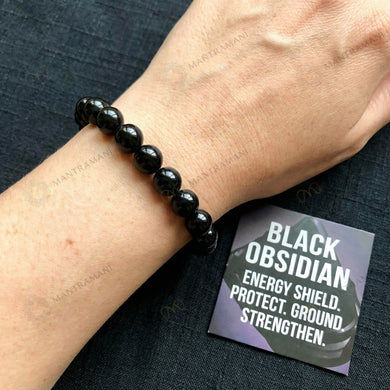
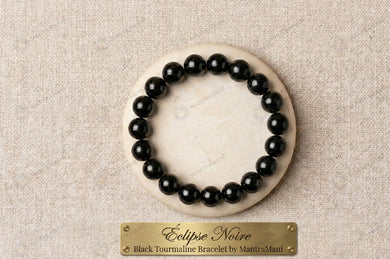
- Protection. Traditionally worn as a shield stone alongside black tourmaline and obsidian. The three are the standard root-chakra protection set.
Real hematite vs the magnetic imitation
Almost every “magnetic hematite” bracelet sold in India is not hematite. It is hematine — a manufactured barium-strontium ferrite composite, made to look identical. It is not a scandal, but it should be labelled, and usually is not.
| Test | Natural hematite | Hematine (synthetic) |
|---|---|---|
| Magnetism | Very weakly magnetic at best — will not hold a paperclip | Strongly magnetic; beads snap to each other |
| Streak test | Leaves a rust-red streak on unglazed ceramic — this is the definitive test | Leaves a grey or black streak |
| Surface | Slight variation bead to bead; polish is deep rather than mirror-bright | Perfectly uniform, mirror-finish |
The streak test is the one that settles it. The name hematite comes from the Greek for blood, and the red streak is exactly why.
Note that strong magnetism is not a mark of quality, despite how it is marketed — it is a mark of the stone being synthetic. If a seller advertises the magnetism as a feature, they are describing hematine.
How to wear hematite
- Hand: traditionally the left wrist for settling and receiving; the right if you want it as a working, outward stone. Our guide to wearing a pyrite bracelet covers the left-right convention in full.
- Day: Tuesday for the Mars association, Saturday for Saturn.
- Care: hematite rusts. Keep it out of the shower, off in the pool, and dry it if it gets wet. Do not soak it in salt water — a common cleansing instruction that will ruin this particular stone. Use dry methods instead, or a selenite plate.
What hematite costs
| Form | Typical MantraMani price |
|---|---|
| Hematite bracelet | ₹749 |
| Golden hematite bracelet | ₹749 |
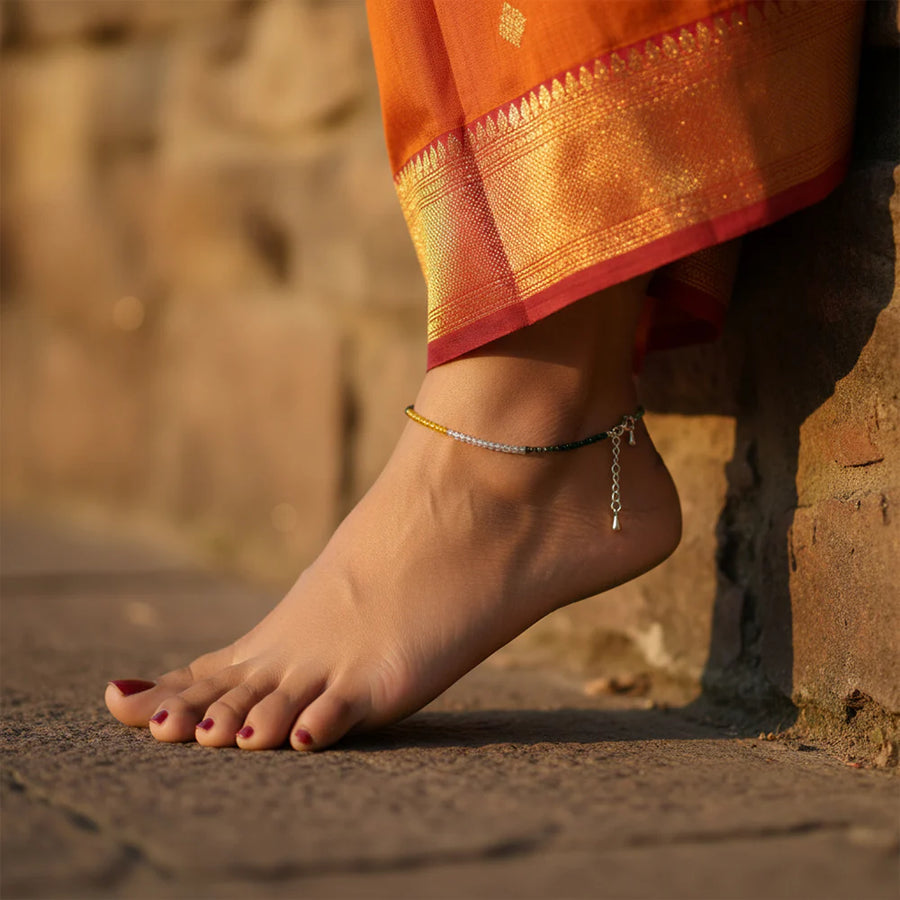
| Hematite anklet | ₹749 |
| Certified loose hematite gemstone | ₹11,999 |
Browse the full hematite collection, or the wider grounding collection. Every order ships with a report from an independent, government-approved, ISO 9001:2015 certified gemmological laboratory; if a stone is ever not what we said it was, the 10X guarantee applies.
Frequently asked questions
Is hematite the same as bloodstone?
No, and the two are constantly confused. Hematite is metallic grey iron oxide. Bloodstone (heliotrope) is a dark green chalcedony with red flecks. Entirely different stones.
Why does my hematite bracelet have rust spots?
Because it is iron and it got wet. This is normal and is actually a point in favour of it being genuine — hematine does not rust. Dry it and keep it away from water.
Can women wear hematite?
Yes. There is no traditional restriction by gender on this stone.
Can I wear hematite with other crystals?
Yes — it is one of the easier stones to combine, and pairs conventionally with tiger eye for focus or black tourmaline for protection.
How many times should the mantra be chanted?
108 is the traditional count, using a mala to keep track. There is no requirement to chant at all if that is not your practice.
Related reading
- Which chakra is blocked? Stones for each of the seven
- Crystals for protection and removing negative energy
- Obsidian benefits: protection, grounding and how to wear
- Gemstone Finder: which gemstone should I wear?
Written by Dr. Padmaja Shastri, in-house Vedic astrologer at MantraMani.
Gemstones and crystals are worn in Vedic and folk tradition as objects of faith. Nothing here is a medical, financial or outcome-based claim. See our disclaimers.