





Karungali (Ebony) Benefits, Who Can Wear It & Real vs Fake
Karungali — karum kali, the black wood — is ebony heartwood, and it holds a place in South Indian practice closer to rudraksha than to any crystal. It is worn as a mala, not a bracelet, and it is associated above all with protection.
It is also one of the most straightforwardly faked items sold in this category, because dyed cheap timber looks identical to the eye. Fortunately it is also one of the easiest to test, and you can do it at home with a glass of water.
Karungali: quick facts
| Also called | Karungali, Karum Kali, Ebony, Kaari, Acharam wood |
| What it is | Heartwood of the ebony tree (Diospyros ebenum) — not a stone, not a seed |
| Traditionally worn for | Protection, grounding, steadiness during meditation |
| Associated with | Shiva; and in Tamil folk practice, guardian deities such as Ayyanar |
| Usual form | 108-bead japa mala |
| Typical price | ₹1,099–₹1,389 for a 108-bead mala |
What karungali is traditionally worn for
Three things come up consistently, and none of them is a health or outcome claim:
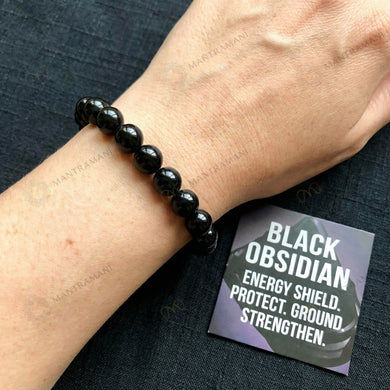
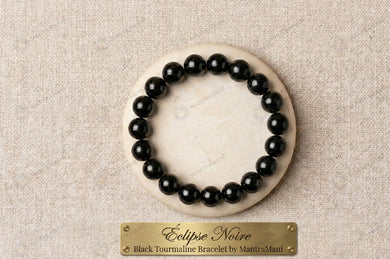
- Protection. This is the core association and the reason most people buy it. In Tamil practice karungali is the standard protective wood, worn or kept in the home against nazar and unwanted influence. It sits alongside black tourmaline and obsidian in the wider protective family — see crystals for protection and negative energy.
- Grounding. Ebony is unusually dense and the beads have real weight for wood. As with hematite, part of the traditional effect is simply that you can feel it.
- Japa and meditation. Karungali is a working mala. It is used for counting repetitions, which is why it is almost always made in 108 beads, or 108+1 with a meru bead.
Who traditionally wears karungali
There is no rashi restriction on it — it is a wood, not a jyotish ratna, so it is not matched to a moon sign the way rashi ratan are. In practice it is worn by:
- Those undertaking a vratam or a fixed period of japa, particularly Shiva-related observances
- People who travel a great deal, on the protection association
- Those advised Shani remedies, since black is Saturn’s colour — though it is not a formal Shani stone. For that, see Shani dosha and Sade Sati remedies
Some traditions hold that a karungali mala worn for japa should not be worn while eating meat or drinking, and should be removed before sleeping. Practice varies by family and region; follow the instruction you were given rather than a general rule from the internet.
Real vs fake karungali: three tests
Most cheap karungali is dyed jackfruit, rosewood or plain hardwood. Genuine ebony heartwood is expensive because the tree grows slowly and only the core is black.
1. The water test — the definitive one
Genuine ebony sinks. It is one of the few woods denser than water. Drop a single bead into a glass of plain water: real karungali goes to the bottom and stays there. Dyed lighter wood floats, or bobs and sits at the surface.
Dry the bead afterwards. This test does no harm.
2. The rub test
Rub a bead firmly on a sheet of white paper, or on a damp white cloth. Real karungali leaves nothing. Its colour is the wood itself. Dyed wood transfers a brown or black smudge, and this is the single most common giveaway in cheap malas.
3. Weight and grain
Pick the mala up. Genuine ebony is startlingly heavy for its size — noticeably heavier than a rudraksha or sandalwood mala of the same bead count. Look at the beads in strong light: real ebony shows a fine, close grain and a slight variation between beads. Dyed wood is uniformly, flatly black with visible open grain.
None of the three is a substitute for a report, but the water test alone eliminates most fakes. Our wider method is in genuine vs fake: how to verify.
What karungali costs
| Form | Typical MantraMani price |
|---|---|
| Karungali ebony mala, 108 beads | ₹1,099–₹1,389 |
| Karungali mala, 108+1 with meru bead | ₹1,139 |
| Karungali and rudraksha combination mala | ₹1,099 |
A word on the price floor. A genuine 108-bead ebony mala below roughly ₹700 is not plausible — the raw material costs more than that. If you are seeing karungali malas at ₹199, you are looking at dyed wood. See the full karungali collection and the wider japa mala range.
How to wear and care for a karungali mala
- Wearing: around the neck, or wound on the wrist. For japa it is held rather than worn, moved bead by bead with the thumb and middle finger, never the index finger.
- Do not soak it. Wood is not stone. A karungali mala should never be cleansed in water or salt water — it will swell and the thread will rot.
- Cleanse dry. Incense smoke, sound, or a night beside a selenite plate.
- Oil it occasionally. A trace of sesame or coconut oil rubbed in with a cloth, once or twice a year, keeps ebony from drying and cracking. This is traditional practice and also simply good for wood.
- Keep it off the floor and stored in a cloth pouch when not in use.
Karungali vs rudraksha vs tulsi
| Traditionally used for | Associated with | |
|---|---|---|
| Karungali | Protection, grounding | Shiva; Tamil guardian deities |
| Rudraksha | Meditation, calm, spiritual practice | Shiva |
| Tulsi | Devotional japa | Vishnu, Krishna |
The conventional rule is that tulsi and rudraksha are not mixed on the same mala, since they belong to different devotional streams. Karungali is commonly paired with rudraksha, and we sell that combination.
Frequently asked questions
Is karungali a stone?
No. It is wood — ebony heartwood. It is grouped with crystals in shops because it is worn for similar reasons, but it needs entirely different care.
Can women wear karungali?
Yes. There is no traditional restriction by gender. Some families follow customs around wearing malas during menstruation; that is a household practice, not a rule attached to this wood specifically.
Can children wear karungali?
It is commonly given to children in Tamil households for nazar protection, usually as a short strand rather than a full 108-bead mala.
My karungali mala has turned slightly brown. Is it fake?
Not necessarily — ebony lightens with skin oils and sun over years. But if the colour comes off on a cloth, it was dyed. Run the rub test.
Does karungali need to be energised?
There is no formal requirement. Common practice is to keep it in the puja area overnight before first use, and to begin on a Monday, Shiva’s day.
What if the mala I buy turns out not to be ebony?
Our 10X guarantee covers it: prove it through an independent NABL-accredited laboratory within 30 days and we refund ten times what you paid. Full terms and exclusions are on that page.
Related reading
- Rudraksha mukhi guide: 1 to 14 mukhi meanings
- How to identify original rudraksha
- Crystals for protection and removing negative energy
- Gemstones for Shani dosha and Sade Sati
Written by the MantraMani Gemstone Desk — our in-house sourcing and authentication team. Any astrological guidance here is reviewed by Dr. Padmaja Shastri, our in-house Vedic astrologer.
Malas, gemstones and crystals are worn in Vedic and folk tradition as objects of faith. Nothing here is a medical, financial or outcome-based claim. See our disclaimers.