









Mulank 1 Lucky Gemstone: Best Stones for Numerology Number 1 (2026)
Mulank — the root number — is the base of ank jyotish, Indian numerology. Unlike your rashi, it needs nothing but your date of birth, which is why it is the most accessible of the traditional systems.
This guide covers Mulank 1. It is the first in a series of nine.
How to calculate your mulank
Add the digits of your birth date only — the day of the month, not the month or year — and reduce to a single digit.
| Born on | Working | Mulank |
|---|---|---|
| 1st, 10th, 19th, 28th | 1 · 1+0=1 · 1+9=10→1 · 2+8=10→1 | 1 |
| 5th, 14th, 23rd | 5 · 1+4=5 · 2+3=5 | 5 |
| 29th | 2+9=11 → 1+1=2 | 2 |
So if you were born on the 1st, 10th, 19th or 28th of any month, your mulank is 1. The month and year do not enter into it — that is the bhagyank, a separate number.
Mulank is not the same thing as your rashi, and the two systems answer different questions. Rashi needs your birth time and place; mulank needs only the date. If you want the Vedic reading, use the Gemstone Finder or read the Rashi Ratan buying guide. We also keep a numerology calculator that works this out for you.
Mulank 1: quick facts
| Ruling planet | Surya / the Sun |
| Birth dates | 1, 10, 19, 28 |
| Day | Sunday |
| Colours | Deep red, orange, gold |
| Direction | East |
| Primary stone | Manik (Ruby) |
| Accessible stones | Red garnet, red spinel, sunstone, tiger eye, carnelian |
What Mulank 1 traditionally signifies
Number 1 is the first number, and ank jyotish reads it fairly literally: beginnings, singularity, the head of things. Surya rules it, so the significations overlap heavily with a strong Sun in a chart.
Traditional strengths
- Leadership. Mulank 1 is traditionally described as happier directing than being directed.
- Originality. The number of the first mover — associated with starting rather than joining.
- Determination. Sun-ruled numbers are traditionally read as fixed once decided.
- Visibility. Recognition and position are Surya’s territory, and 1 shares it.
The traditional difficulties
Every number in ank jyotish carries a cost, and describing only the strengths would be flattery rather than the tradition:
- Rigidity. The same fixity that reads as determination reads as inflexibility from the other side.
- Ego. Classical texts are direct about this one where Surya is concerned.
- Difficulty collaborating. 1 is a single unit; partnership is 2’s territory.
- Impatience with instruction. The recurring note across sources.
The stones for Mulank 1
Because Surya rules the number, the stones are the Sun’s stones. The full planetary picture is in Sun (Surya) gemstones: the complete jyotish guide.
| Stone | Note | Typical price |
|---|---|---|
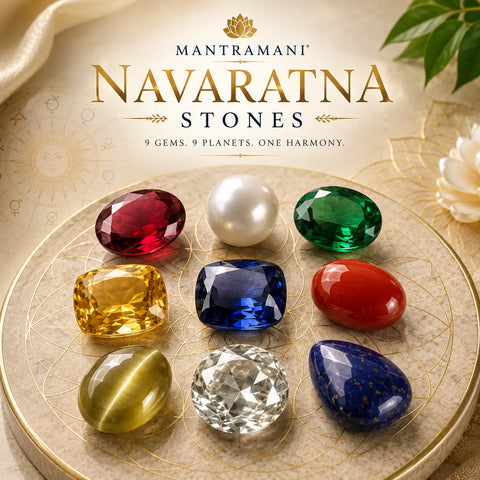
| Manik (Ruby) | The primary ratna. Certified, expensive, traditionally worn after a chart reading. | Graded individually |
| Red Spinel | The closest accepted substitute. Historically confused with ruby for centuries. | Mid |
| Red Garnet | The affordable everyday option, and genuinely natural. | ₹499–₹749 |
| Sunstone | Linked to Surya by name and appearance. | ₹749 |
| Tiger Eye | Golden, solar plexus, worn for confidence under pressure. The usual starting point. | ₹700–₹900 |
| Carnelian | Modern crystal choice for drive and self-belief. | ₹700–₹900 |
Browse the ruling number 1 collection or the Sun collection.
A counterweight worth knowing. Traditional practice for a strong Mulank 1 is not always to add more Sun. Where the difficulty is rigidity rather than weakness, the conventional advice is a balancing stone — Moti (Pearl) for the Moon, or amethyst in the semi-precious range. Adding to what is already strong is not automatically the remedy.
How to wear
- Metal: gold or copper for Surya stones.
- Finger: ring finger, if worn as a ring.
- Day: first worn on a Sunday morning.
- Hand: the left-versus-right convention is set out in how to wear a pyrite bracelet.
- Care: ruby, garnet and tiger eye are all hard and tolerate water and sunlight. See how to cleanse and charge crystals.
Frequently asked questions
Is mulank the same as my rashi?
No. Mulank comes from your birth date alone and belongs to ank jyotish. Rashi is your moon sign and needs birth date, time and place. Neither replaces the other.
What if my mulank and rashi stones conflict?
Traditional practice gives precedence to the chart. Mulank is the simpler system and is generally treated as supplementary where the two disagree.
Can I wear a Mulank 1 stone if my mulank is not 1?
The semi-precious ones, yes — garnet, tiger eye, carnelian and sunstone carry no restriction. The certified navratna are the ones traditionally worn on advice.
What is bhagyank?
The destiny number, from your full date of birth — day, month and year reduced to a single digit. Mulank describes disposition; bhagyank is read as the arc of a life. They are frequently different.
Is number 1 lucky?
Ank jyotish does not grade numbers as lucky or unlucky. Each carries strengths and difficulties, and the remedies address the difficulties.
The rest of the series
Mulank 2 to 9 follow in this series. See also the numerology calculator and shop by ruling number.
Related reading
- Sun (Surya) gemstones: the complete jyotish guide
- Manik (Ruby): benefits, who should wear and price
- Rashi Ratan buying guide 2026
- Leo gemstone: ruby and the best stones for Simha Rashi
Written by Dr. Padmaja Shastri, in-house Vedic astrologer at MantraMani.
Gemstones and crystals are worn in Vedic and folk tradition as objects of faith. Nothing here is a medical, financial or outcome-based claim. See our disclaimers.
Original Dhan Vriddhi™ Money Magnet Bracelet
100% Govt Lab-Certified natural gemstones energized with sacred Vedic mantras. Backed by MantraMani's 10X Authenticity Guarantee.