














Crystal Anklets (Payal): Meaning, Benefits & How to Wear
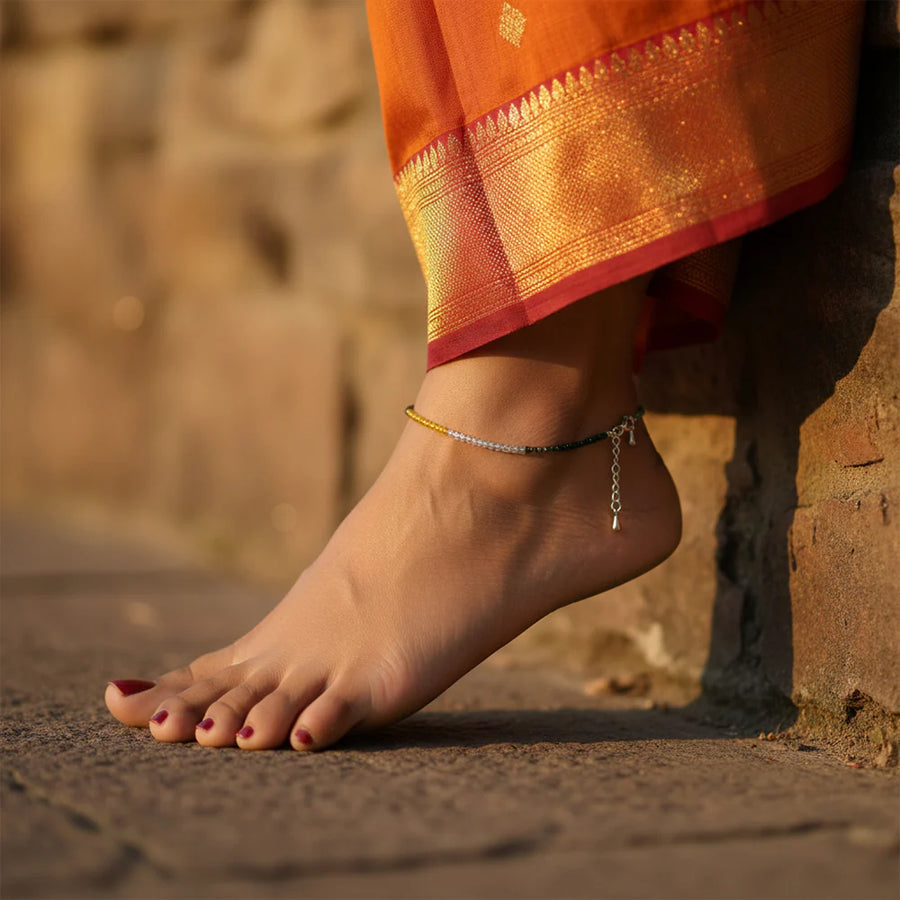
The payal is one of the oldest pieces of Indian jewellery still worn daily, and the crystal version is a fairly recent hybrid: gemstone beads strung where silver bells used to be.
It is not simply a bracelet worn lower down. The position changes which stones suit it, how long it lasts, and what tradition says about wearing it at all.
Why the ankle, not the wrist
Two reasons, one traditional and one practical.
The traditional one. Indian custom draws a firm line at the waist: gold above, silver below. Gold is associated with Surya and the upper body; wearing it on the feet is traditionally avoided as disrespectful. This is why payals are silver and why a gold anklet is rare in Indian households regardless of cost.
Crystals sit outside that rule — they are neither — which is part of why crystal anklets caught on.
The practical one. Anklet stones are traditionally grounding stones. The root chakra is at the base of the spine and the association runs downward, so the stones that suit an anklet are the ones you would otherwise wear for steadiness rather than for clarity or communication.
Which stones suit an anklet
| Stone | Traditionally worn for | Price |
|---|---|---|
| Turquoise (Firoza) | Protection, communication | ₹849 |
| Red Garnet | Vitality, steady energy | ₹749 |
| Labradorite | Intuition, protection | ₹749 |
| Peridot | Abundance, positive energy | ₹599 |
| Blue Chalcedony | Calm, balance | ₹549 |
| Amazonite | Communication, calm | ₹749 |
| Black Rutilated Quartz | Grounding, protection | ₹749 |
| Hematite | Grounding — but see the care warning below | ₹749 |
Most sit in the ₹549–₹849 band. Browse the full crystal anklet range.
Stones to avoid at the ankle
Not for mystical reasons — for durability. The ankle takes far more knocks than the wrist.
- Selenite — soft, and dissolves in water. It will not survive a monsoon.
- Malachite, turquoise in low grades — soft and porous; scuffs quickly at this height.
- Hematite — works well, but it rusts. Fine indoors, poor if you walk in rain.
- Certified navratna — nobody wears a certified Pukhraj on an ankle. Jyotish ratna are traditionally worn on the hand or neck, where the prescribed finger and metal apply.
Which foot?
Honest answer: tradition is not consistent on this, and anyone who states a single rule is overstating it.
What is consistent:
- Both, in most Indian households. Payals are conventionally worn as a pair. The single-anklet convention is largely Western.
- Left for receiving, right for projecting — the same convention that governs bracelets, set out in how to wear a pyrite bracelet. If you wear one only, left is the usual choice for protective and calming stones.
- Married women in many communities wear payal as part of the customary set alongside toe rings. That is a social convention rather than an astrological one.
Care — this is where anklets actually fail
Anklets break far more often than bracelets, and almost always for the same reasons.
- Take it off in the shower. Soap and shampoo residue works into the elastic and rots it faster than water alone.
- Take it off for sport and sleep. The two highest-snag activities.
- Expect to restring. An elastic anklet worn daily lasts roughly six to twelve months. That is the material, not a defect.
- Rinse off sea and pool water immediately. Salt and chlorine both attack the cord and several of the softer stones.
- Clean dry where possible — see how to cleanse and charge crystals.
On breakage: tradition reads a snapped thread as the piece having finished its work rather than as bad luck. Practically, it is friction. Both readings point the same way — restring or replace, do not agonise.
Anklet vs bracelet: which to buy
| Anklet | Bracelet | |
|---|---|---|
| Best stones | Grounding, protective, hard-wearing | Any, including soft and certified stones |
| Visibility | Low — suits workplaces with jewellery rules | High |
| Durability | 6–12 months of daily wear | Longer |
| Jyotish ratna | Not traditionally worn here | Yes, on the prescribed finger |
If you want the stone for astrological reasons, buy the bracelet or ring. If you want it worn constantly and discreetly, the anklet is the better object.
Frequently asked questions
Can men wear crystal anklets?
Yes. The payal is customarily worn by women in most Indian communities, but there is no traditional prohibition, and plain crystal anklets are worn by anyone.
Should I wear one or two?
Two is the Indian convention. One is a personal choice and is equally common now.
Can I wear an anklet with a certified gemstone?
It is not traditional. Jyotish ratna carry instructions about finger and metal that an anklet cannot satisfy.
Why did my anklet break so quickly?
Almost always shower soap in the elastic, or a snag while sleeping. Six to twelve months is normal life for daily wear.
Do you charge for delivery?
No. There is no shipping charge and no minimum order. Cash on delivery adds ₹49; paying in advance takes a flat 5% off.
Related reading
- Crystal bracelet guide: types, benefits and how to choose
- How to cleanse and charge crystals
- Which chakra is blocked? Stones for each of the seven
- Turquoise (Firoza) benefits and real vs fake
Written by the MantraMani Gemstone Desk — our in-house sourcing and authentication team. Any astrological guidance here is reviewed by Dr. Padmaja Shastri, our in-house Vedic astrologer.
Gemstones and crystals are worn in Vedic and folk tradition as objects of faith. Nothing here is a medical, financial or outcome-based claim. See our disclaimers.